
                                                                           Â
Â
TheGardenLady received this question from Joyce.
IÂ love marigolds but am unable to keep them healthy. I have had the same problem in the past and gave up on them for a while. Now several years later the problem still persists. The foliage looks fine but the flowers and buds (all stages) are full of worms. They are about 1/8-1/4 inch size, vary from brown to beige in color and leave behind a sawdust-like residue on the flower. They burrow into the seed pod and even flowers that look unaffected have the critters inside. None of my other annuals are affected. They are all grown in containers on a balcony. Any thoughts and any treatment suggested would be welcome.
Marigolds, Latin name Tagetes, are usually one of the easiest annual flowers to raise because they have so few pest problems. In fact, they are often used to prevent problems for other plants because they get rid of nematodes in the soil. They are used as companion plants.  See here. Â
But like most plants, Marigolds like to have their environment just as it was in their place of origin. Marigolds, in spite of some of their names, originated in Mexico and Central America. There they had lots of sun and not too rich soil. Marigolds, if raised in an area where they do not get the conditions they want are more susceptible to problems. See here.
Remember that the best method of reducing insect and/or disease problems is to keep the plants growing vigorously and free from stress. There are certain cultural practices that should help to reduce insect and disease problems: (1) select a planting site which provides desirable growing conditions for a particular annual – your balcony might not be the best location for marigolds; (2) if they are on your balcony, avoid planting in corners where light intensity and air circulation are minimal; (3) keep marigolds growing vigorously by placing them in the sun, not using too much fertilizer and not too much irrigation- they like dryness.(4) avoid allowing them to wilt since water-stressed plants are more susceptible to infestation by thrips and red spider mites; (5) remove dead flowers from marigold plants which do not naturally fall from the plant; (6) prevent pathogenic fungal spores from germinating by watering early in the morning and keeping water off plants as much as possible (7)provide good air circulation around plants by allowing ample space between plants; and (8) remove weeds from flower beds and monitor annuals frequently since they are host to insects and/or disease organisms. See here.
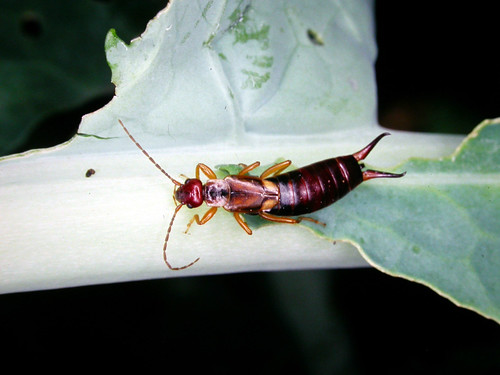
There are slugs, snails and insects that do attack marigolds. Though you describe worms, TheGardenLady suspects that your marigolds are being eaten by earwigs which are not worms. The below website has a photo of the damage earwigs do to marigolds.
In the future, any reader who has a problem is advised to send in a photo with a close-up of the problem and a description of the location the plant is in. This will help TheGardenLady enormously in diagnosing.
Joyce, if TheGardenLady is incorrect on this diagnosis of earwigs, please send a good, clear photo of the problem with a photo of your “garden site.” TheGardenLady will be happy to continue researching your problem.
This website has problems of marigolds.Â
For this summer, though there are methods of treating earwigs, if that is what your plant has, TheGardenLady suggests that you toss out the marigolds you have with the problem. (They are cheap plants not worth the time and effort of trying to salvage them.) Buy some new marigolds or start them yourself. Use average to poor soil – soil from outdoors is perfect- to pot the marigolds and give them ample soil for their roots to grow in. Do NOT use fertilizer enriched potting soil for marigolds. Put the marigolds in their pots in FULL sun. Do not mulch the marigolds. Do not keep the marigold pots damp. Let marigold soil dry out between waterings- but do water regularly; don’t let the plants wilt. Pinch off any dead or dying parts- leaves, seed pods and flowers.
Please let TheGardenLady know if her advice helped. A photo would be welcomed.
marigolds r planted around edge of garden & r watered 2x a week with the rest of the garden. after a month they just started dying with no visible infestation. last year marigolds were planted in same vicinity under a citrus tree & they survived just fine. plants were bought at lowe’s garden center both times. HELP!
Hi,
I have problems with earwigs as well and now use a strong insecticide to kill them. Earwigs come out of the big blossom when I shake them. Now the earwigs are gone. The second problem with marigold blossoms is some small insect, burrows into the bud under the blossom causing the blossom on only grow half its size and eventually turns brown. It has a black pepper look to the petals. I suspect thrips or spider mites are the cause but am not sure. The first lady talked about worms inside the buds. I saw those in the spring as well. They are about 1/4 in long and mine were a light grey color. They devour the buds before they even open. However again I used a mixture of insecticide sprays about twice the recommended strength and killed them off. I think the only way one can tell if spider mites or thrips are the problems is to examine the buds under a mircroscope and if present use a strong insecticide that is residual. Meaning it stays on the plant. Soap based insecticides only work if it touches the insect. Whats your opinion.
Mike
I have an issue with caterpillars in my marigolds just like Joyce from a previous comment. You suspected that she had earwigs. I have earwigs also and that is not the problem. Every bud, every flower had a light brown/tan caterpillar eating away at it. I have a picture but I am not sure how to post it so you can see it.
My marigolds have worms in the seed pod under the flower. Some even have 2 worms in them! Definitely not earwigs.
That’s my problem too!!! They are eating through my flowers and most of the seeds!
I have worms inside the buds of the marigolds. They are not earwigs. Some buds have a hole at the base. Others do not. It is a small grayish worm with a stripe.
The worms eating the marigolds are sunflower moths
Some here – something that looks like pepper but clumped together and grubs inside them. Flowers are only half developing and then dying off. I hate using pesticide but I have no choice. What is the best pesticde?
I have been looking and looking trying to figure out what these worms are. They are definitely NOT earwigs. I have big marigolds and tiny little gem marigolds. The gems suffer the most with all the buds dying before opening. The bigger ones can stand the worms because thee is so much more to eat. Thank you Dana for your ID. When I saw the pictures I shouted, “That’s it!”
https://ag.umass.edu/greenhouse-floriculture/photos/sunflower-moth-caterpillar-marigold
Is anyone going to offer a solution to these nasty little worms??? I just clipped every flower and every new bud to try to slow these pesty critters from devouring my plants!!!
Sooooo no new solutions? These wormy critters/sunflower moth larvae absolutely destroyed my marigold crops. In futility of loosing to the problem I decided to uproot them all and try again next year.
I have the worms aswell , they were un-noticed until the marigold is picked. My son likes to pick the flowers for me , they are very heathy beautiful alive although did not notice the worm until my son kept picking them for me I would leave them in my car and after a few sightings of ” the worm ” I realized their domain .
My marigolds started as seeds I did not move them outside until July with all the rain this year I waited , they started to bloom very vigorously with the worm present , I do not believe the worm is the harmful insect to the marigold , mine are planted in partial ruff and mixed soul next to an old trunk root from my old hedges .
Nancy found this link via Dana https://ag.umass.edu/greenhouse-floriculture/photos/sunflower-moth-caterpillar-marigold
and the link says the treatment is “Bacillus thuringiensis subsp. kurstaki” which I searched for:
https://www.google.com/search?q=Bacillus+thuringiensis+subsp.+kurstaki&oq=Bacillus+thuringiensis+subsp.+kurstaki&aqs=chrome..69i57&sourceid=chrome&ie=UTF-8
Hopefully one of these treatments works. Our marigolds do not have the worms but these tiny black mites. I found them while dead heading the marigolds. You open the pod up and see these things, really tiny, no legs, looks like their dead.